






















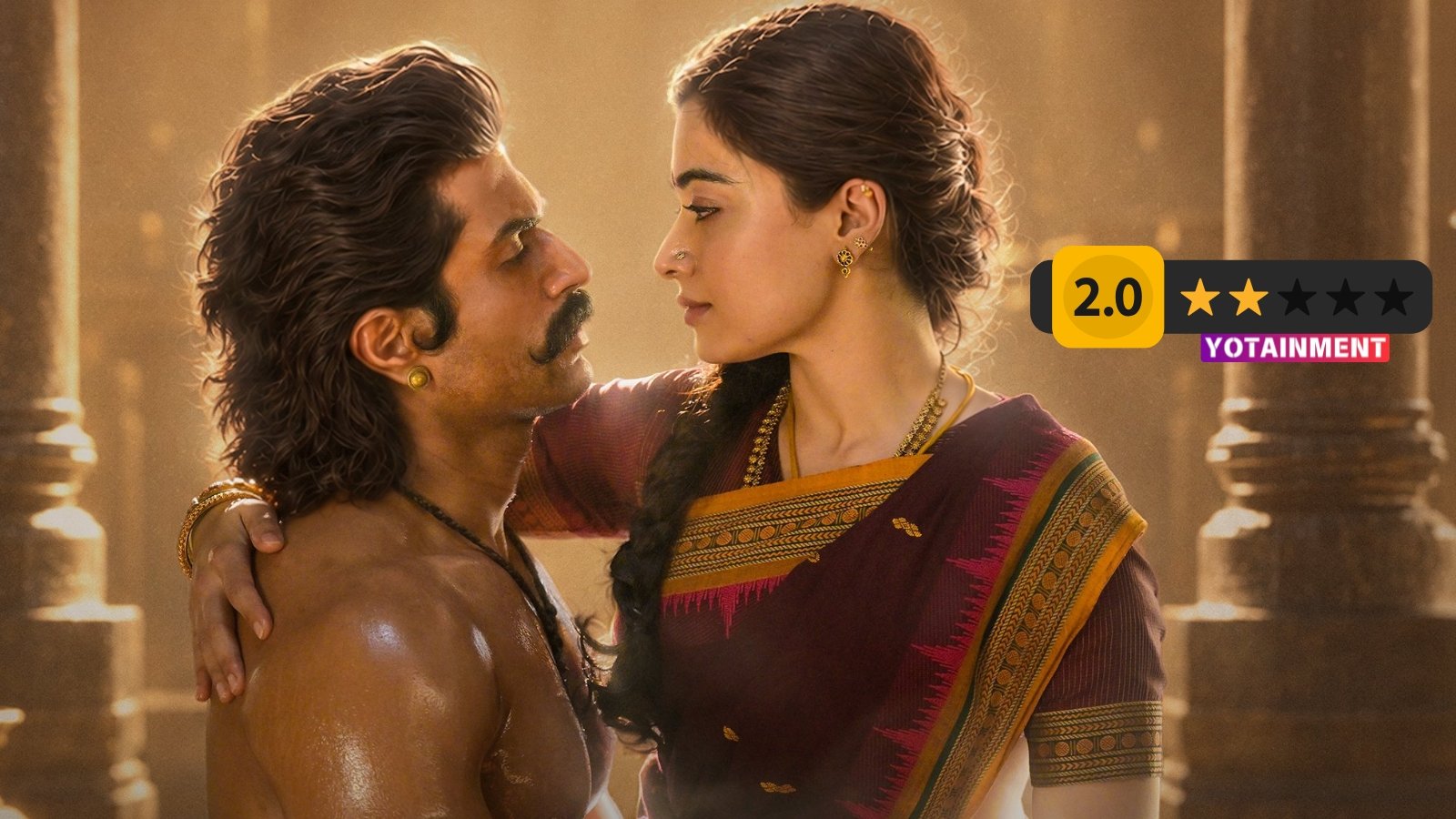
Vijay Deverakonda steps into the shoes of a fierce warrior fighting British oppression, but can his intensity carry a period drama that struggles to turn its powerful premise into an equally gripping cinematic experience?
Set during the Great Madras Famine of 1876-78, Rahul Sankrityan’s Ranabaali takes on a painful chapter of Indian history, exploring colonial exploitation, widespread starvation and the resistance of a man who rises to protect his people. The subject has weight, the period setting feels carefully constructed, and Vijay throws himself into the role. Yet, despite a promising first half and some striking moments, the film gradually gets trapped in repetitive confrontations and familiar mass-action tropes.
The intention is powerful. The execution, unfortunately, doesn’t always hit the mark.
At its core, Ranabaali wants to be both a historical drama and a larger-than-life action spectacle. It has the scale, the violence and the heroism, but the emotional connection needed to make this journey truly memorable keeps slipping away.
Ranabaali Story: A Powerful Chapter of History That Deserved Better Writing
Set in Rayalaseema during the late 1870s, Ranabaali follows Singanamala Bobbili Ranabaali, a fearless local warrior who finds himself fighting against British oppression as famine devastates the region.
Vijay Deverakonda plays a man who is known for his brutality long before he becomes a protector of his people. He is quick to draw his weapon, commands attention wherever he goes and carries himself like someone who has never learned to fear anyone. But when the British administration tightens its grip on the village and the suffering around him becomes impossible to ignore, his fight takes on a larger meaning.
The film’s backdrop is its biggest strength. The famine is not treated as a passing detail, and the images of starvation, helpless families and colonial officials carrying on with their lives create some deeply uncomfortable moments. The contrast between the suffering of ordinary Indians and the indifference of those in power gives the story a strong foundation.
Director Rahul Sankrityan clearly wants to bring a lesser-explored chapter of history to a mainstream audience. There is ambition in that decision, and the film deserves credit for taking up a subject that carries considerable emotional and historical weight.
However, a powerful subject alone cannot hold a nearly three-hour film together. Ranabaali has a story worth telling, but its screenplay repeatedly struggles to turn that story into compelling cinema.
First Half: The World-Building Works, and the Interval Raises Expectations
The first half is where Ranabaali finds its footing. The chapter-based narration helps establish the period, introduce the key characters and gradually reveal the world Ranabaali inhabits. There is a sense of scale to the proceedings, and the conflict builds as the British presence begins to disrupt village life.
Ranabaali’s introduction establishes him as a man of extraordinary physical strength and an intimidating reputation. His violence is part of his identity, but the film also begins to show the person beneath that fearsome image.
The arrival of Jayamma, played by Rashmika Mandanna, brings a welcome change in mood. Their arranged marriage creates room for playful exchanges, warmth and a more personal side to the protagonist. These scenes feel noticeably more natural than the stretches built around aggression and revenge.
The pre-interval portions also give the film some of its strongest dramatic moments. As the scale of British exploitation becomes clearer, Ranabaali’s personal world begins to collide with the suffering of his community. The tension rises, and the interval leaves viewers expecting the film to take this conflict to another level.
For a while, the pieces seem to be falling into place. The historical setting is engaging, the central relationship adds emotional depth, and Vijay’s screen presence keeps the narrative moving.
The problem is that the second half does not build on this promise consistently.
Second Half: Repetitive Conflicts Take Away the Impact
After the interval, Ranabaali leans increasingly on familiar confrontations between the protagonist and the British authorities. The cruelty continues, Ranabaali responds with fury, and the film returns to the same emotional territory without giving these encounters enough new dramatic weight.
The violence is often graphic, but shock value has its limits. When one brutal sequence follows another, the audience gradually becomes accustomed to the imagery. Scenes that should leave a lasting emotional impact begin to feel repetitive instead.
This is where the film loses a major opportunity. The famine and the suffering of ordinary people could have provided a powerful emotional core, allowing the audience to understand not just why Ranabaali fights, but what the fight costs him. Instead, the screenplay often rushes towards another act of heroism before fully exploring the human consequences of what has happened.
The protagonist himself also needed more emotional range. His anger and determination are clear, but his vulnerability remains underdeveloped. For a character surrounded by such immense suffering, the film rarely spends enough time exploring the inner conflict that might make his transformation into a saviour genuinely moving.
The final stretch attempts to bring the story to a grand, mythological conclusion. There are moments of spectacle, but the payoff arrives after too much repetition. Certain elements also feel familiar from recent Indian action and folklore-driven films, reducing the sense of originality that the first half initially establishes.
The issue isn’t that Ranabaali lacks scale. It’s that the spectacle keeps getting in the way of the story.
A tighter screenplay and sharper editing could have made a considerable difference.
Vijay Deverakonda: Full Commitment, Limited Emotional Depth
Vijay Deverakonda clearly puts substantial effort into playing Ranabaali. His physicality suits the character, and he brings the required aggression to the action sequences. The way he carries himself, handles the weapons and moves through the frame helps establish the warrior’s intimidating presence.
There are moments when his intensity translates into an effective big-screen experience, particularly when the character confronts those responsible for his people’s suffering. The larger-than-life presentation gives Vijay plenty of opportunities to command attention.
Yet the performance is held back by the writing. Ranabaali spends much of the film switching between rage, defiance and revenge, leaving Vijay with limited room to explore the emotional layers beneath the warrior image.
Interestingly, his scenes with Rashmika are among his most engaging. When the film allows him to step away from the violence and simply interact with Jayamma, a more relaxed and appealing side of the character emerges.
The effort is visible, but the screenplay does not always give that effort enough to work with.
Rashmika Mandanna Brings Much-Needed Warmth
Rashmika Mandanna’s Jayamma is an important source of emotional balance in a film dominated by bloodshed and confrontation. She brings warmth, humour and a grounded quality to the role, making her scenes with Vijay some of the more enjoyable portions of the narrative.
Their chemistry feels easy rather than forced. The playful moments between the couple offer a welcome break from the film’s relentless intensity, while Jayamma’s assertiveness ensures she is not simply there to admire the hero.
Rashmika also helps bring out the human side of Ranabaali. Their relationship gives the audience a glimpse of the life he might have had beyond the battlefield, making the contrast with his violent world more apparent.
The frustrating part is that the film does not make full use of this relationship as the story progresses. Jayamma could have played a more central role in the emotional journey, but the screenplay increasingly shifts its attention towards the hero’s confrontations and larger-than-life moments.
Still, Rashmika leaves a mark. Whenever the film returns to the couple’s personal world, the storytelling feels more grounded.
Arnold Vosloo and the Supporting Cast
Arnold Vosloo plays Sir Theodore Hector, the British official whose ruthless approach to administration places him in direct conflict with Ranabaali. Vosloo brings an imposing presence to the role, but the character often feels more like a symbol of colonial cruelty than a fully developed antagonist.
The British officers are written in similar shades, and their repeated confrontations with Ranabaali eventually lose their dramatic force. A more distinctive villain with a stronger psychological presence could have given the central conflict greater tension.
Easwari Rao, as Ranabaali’s mother Rajamma, contributes to the family drama, while the other supporting performers help establish the social and cultural world around the protagonist. The film has several characters who could have added more emotional depth, but many remain on the sidelines as the central narrative returns to its hero-versus-oppressor structure.
The cast does its part, but the writing does not always give these characters enough room to make a lasting impression.
Direction, Action and Technical Departments
Rahul Sankrityan deserves credit for choosing an ambitious subject and attempting to bring a difficult historical period to the screen through mainstream Telugu cinema. The film’s opening stretch shows that he understands the potential of the material. The world-building, famine backdrop and early character dynamics offer glimpses of a much more affecting film.
The direction becomes less assured when the story shifts into repetitive confrontations and prolonged dramatic stretches. The film seems increasingly focused on delivering another heroic moment rather than allowing the existing ones to settle with the audience.
The action is staged with a clear emphasis on physicality and scale. Several sequences are visually forceful, and the choreography is generally easy to follow. However, the sheer frequency of violence works against the film. Not every confrontation needs to be bigger than the previous one, especially when the story already has such a devastating human tragedy at its centre.
The production design by Shivam Rao Nagasani is one of the film’s notable strengths. The period setting feels carefully assembled, helping create a convincing picture of life in the region during the famine. Cinematography by Jishnu Rao Bhattacharjee and Nirav Shah gives the film a sense of scale, although the visual treatment does not always translate into emotional engagement.
Ajay-Atul’s music and background score, meanwhile, are a disappointment. The score supports some of the romantic moments, but it rarely lifts the heroic sequences to the level the film seems to demand. For a story built around resistance, sacrifice and the suffering of an entire community, the music needed a stronger emotional and dramatic presence.
The result is a film that often looks more convincing than it feels.
Ranabaali Movie Review: What Works and What Doesn’t
What works in Ranabaali is its historical setting, the effort behind the period recreation, Vijay Deverakonda’s physical commitment and the chemistry between Vijay and Rashmika. The first half has enough intrigue and dramatic momentum to make the premise engaging, while a handful of action and emotional sequences show what the film could have achieved.
What doesn’t work is the repetitive screenplay, the excessive reliance on violence, the underdeveloped emotional journey and a second half that struggles to maintain the promise of the opening stretch. The antagonists lack distinct personalities, the background score fails to provide the expected lift, and the long runtime makes the weaker passages more noticeable.
The biggest disappointment is that Ranabaali has all the ingredients for a gripping historical action drama, yet it keeps choosing familiar heroics over deeper character development.
Also read: Jailer 2 Review
Ranabaali Movie Review: Final Verdict
Ranabaali is a sincere attempt to bring a painful chapter of Indian history to the big screen, backed by committed performances and impressive production design. Vijay Deverakonda gives the role his all, while Rashmika Mandanna brings warmth to a narrative that often gets lost in its own violence.
But strong intentions and a commanding hero are not enough to carry a film of this scale. The first half builds expectations that the second half struggles to fulfil, and the repeated confrontations eventually drain the story of its emotional force.
The film has moments that work, but not enough consistency to make the entire journey worthwhile.
The Review
Ranabaali
Ranabaali has a powerful historical backdrop and a committed Vijay Deverakonda, but repetitive writing, excessive violence and a disappointing second half weaken its impact. A promising premise that fails to deliver a gripping cinematic experience.
PROS
- Vijay Deverakonda’s committed performance and commanding screen presence.
- Vijay and Rashmika Mandanna’s natural chemistry.
- Impressive period setting and production design.
CONS
- Underwhelming background score and predictable climax.
- Repetitive screenplay and a dragging second half.
- Excessive violence weakens the emotional impact.